16 April 2017

The End Of The Road (6)

The conclusion to our genius project voyage is upon us. These past six weeks have been full of new adventures and experiences for all of us. Whether you continue to work your way towards 10,000 hours in your hobby or not, the lessons you learned from it will always be with you. For me, stand up comedy has most certainly been a route of inspiration. It quickly became a stress relieving technique that I used while working my way through homework. When my parents said that I was procrastinating by watching Louis C.K., I would just respond with, "I'm studying, Mom!"


Even though I will most likely stop practicing stand up once this project is over, it is important to reflect on my comedy experience. First off, stand up comedy is much harder than it seems. I set aside 1 hour one day to write a routine and then the rest of the day was going to be spent on video games. I ended up taking 5 hours to write the routine. With no breaks or snack interruptions, it still took me 5 times the amount of time I thought it would take. After all, I'm just describing my thoughts about a certain subject. It shouldn't have been that hard, but for some weird reason, it was. The lesson learned is not to underestimate someones craft. Do something before you judge it.


Now for a reflection on the Ted talk I gave. I had many different ideas for themes to talk about during the presentation. I had so many little messages to spread, but nothing really stuck out to me. I finally decided to talk about noticing small things in life based off of what Joe Conklin told me. The next step for me was to write some jokes. In my case, I ended up drawing the jokes. The jokes ended up getting laughs but I with I embedded more jokes throughout my talk. My delivery was stronger and more fluid than it was in my practices. I am overall satisfied with the Ted Talk I gave even though I wish it was more of a stand up routine as opposed to a presentation.

In the end, I am happy to have had the opportunity to have tried something new and to have learned new skills from it. Although I have already found passion elsewhere, it was fun trying something different for a change. The lessons I've learned from comedy will stick with me long after I stop doing comedy. 

24 March 2017

Attempted vlog and Log (5)

This vlog was almost as big of a fail as my blog posts 1, 2, and 3. My biggest problem is that I was too confident and I thought that I could come up with things off of the top of my head and they would be funny. While some of the jokes were pretty funny, I couldn't continue with the joke. To compensate for this fact, I made a compilation of some of the funniest jokes I made up. Keep in mind that some of my ideas for my vlog changed over time. Instead of just writing a full routine when I realized that this improvisational technique wasn't working, I decided to stick with it because it still shows the idea of making jokes up on the spot, which is what I've been working on this entire week. Enjoy these random clips of me trying to be funny. (I'm actually just super awkward and random in the video which makes it kinda funny)


Comedy...kinda from Alejandro T on Vimeo.

Along with the vlog, I also wanted to talk a little bit about comedic styles. Comedic style is the idea that not all comedy has to be delivered in the same way. Some comedians are extremely enthusiastic and full of emotions when they are speaking while others may tend to be straight-forwards and awkward. For example look at these two stand up routines, Darik Santos and Kevin Hart. The Kevin Hart one is a long video so just fast forward to a random part and watch like 1 minute or 2. Darik Santos is one of the most awkward people I have ever seen, but he does what a great comedian would do, and he uses that to his advantage. His jokes are stupid. So stupid that they make you laugh. That's the thing about this form of comedy. Awkward is funny. Not all comedy is made for the audience to laugh with the comedian, sometimes the comedian purposefully wants the audience to laugh at them. Looking at the Kevin Hart video, you see that he really feels what he is saying. If the story he is telling is full of pain, then he looks hurt. If the story is full of positivity, his voice reflects that.

The point of showing this is to explain how comedy isn't one sided. Many people might not understand a certain form of stand up, while others could die laughing at the same routine. There is an infinite number of ways to make a stand up routine. Look at Andy Samburg in this Harvard Ceremony. Its incredible how a good joke can fit any occasion.

23 March 2017

Interview: Joe Conklin

Introducing Joe Conklin. He does comedy and impressions in the Philadelphia area. You can find him on his website or on his YouTube channel. Much of his comedy is about impersonating Philadelphia sports players. He graduated from Temple University and has been in the comedy business for quite some time now.


My experience finding an expert was pretty straight forwards. While visiting and talking previous teachers, the subject of this project came up. Don't ask how or why it came up, just go with it. My ex-teacher then started talking about how she had recently seen a comedian do impression by the name of Joe Conklin. After a few days, I decided to finally look this mysterious guy up on the internet. I came up with the links provided previously in this post. Anyhow, I couldn't find his email anywhere. The only thing I found was a link to fill out a forum to hire Joe Conklin for an event. I was about to hire him too, but that's when I realized that I could send him a YouTube message. No, I don't mean a comment, I mean the hidden button on YouTube channels that acts as an email. After I sent an email, he responded fairly quickly. The response was, of course, yes. I then made a mistake that I would regret for the following week. A mistake that made me think that I sabotaged my own interview. The mistake was that I forgot to reply. The following day, I also forgot to reply. This continued until I finally decided to send him a response with some questions a week afterwards. Now, if he didn't respond to this, my gifted grade would surely go down the drain. He didn't respond. I would end up waiting an entire week until I decided to send him another message. This time he was quick to respond with the answers to all of my questions:

1. How did you get into comedy?
I have been doing impressions since I was a little kid, maybe 5-6 years old.  I used to imitate the voices of my uncles, neighbors and teachers.  I’m one of 7 kids and many of my siblings and even my parents used to do voices –put on affectations while telling stories and breaking chops, so it was pretty much in my family growing up.

2. What makes a good comedian?  
Observe and report, simple as that.  You must be able to see what is happening: in a situation, in your house, in the world; and how it effects people.   Observing the subtle nuance of people and situations is a key.  A person’s style, ability and articulation then comes in to play in the reporting of your observations.  Tell the world what you saw, what you know.

3. What were some of the major stepping stones for you in your career?  
Always be on the lookout for a stage, a microphone or any crowd willing to listen.  For me it was when company came around for holiday dinners with my aunts, uncles, cousins.  As I got older it was the microphone in church (reading as a lector) and in high school as PA announcer at the basketball and football games.  Then later at charity events, fundraisers.  These events are always looking for volunteers and people who will entertain for free.

4. Do you have any suggestions for an aspiring comedian?  
See the previous answer.  I think that is a good road map.  And start with assembling your best 3 minutes of material, memorize it until you have it down.  Then perform it in public over and over again.  Make changes as you find out what works and what doesn’t. 

5. How do you come up with your routines?  
Constant observing and reporting of what I see on TV, walking down the street, in the store, driving in my car, etc.

6. How do you improve yourself as a comedian?  
Edit, edit, edit.  Keep chiseling away at your jokes, yours scripts until you have no extra words.  Two rules have helped me that I learned in a composition class in college: 1) Every slashed syllable is a good deed.  And 2) If it doesn’t add, it subtracts.   (the shorter you can say something the better and more effective it is). 


I thought it was interesting how he considers his comedy career to have started when he was still a small child. He also considered his training to consist of public speaking at church and with family. As someone who has read at church and is on the school's debate and speech team, this response made me feel so much more confident about my comedy career. It showed me that I'm not completely brand new to the comedy world. Another part that I found interesting, is how he finds comedy in the world around us. Last week when I was thinking of an idea for my stand up routine, I thought of what he said. This made me realize something that has taken me about 10 years to realize. Lastly, he said something that was Mr. Perlman-esque. In that "if it doesn't add, it subtracts". This has gotten me to think more about how to relate my comedy routines to something I'm more familiar with like an essay. I was so fascinated with what Joe Conklin was saying that I had to learn more.  I later asked how he decides on what parts of his routines he cuts and what parts he builds around. He responded, "I try out my jokes on the people around me: family, friends, students, parents and on social media. Gauge the reaction."  This is interesting in that he uses his the people around him in order to make his routines. I would've thought that he did all of his writing by himself, and that it would automatically be this brain-bursting comedy routine that would have everyone rolling around on the floor like if they were getting tickled shortly after he introduced himself. This refining process is really brings out the artistic part of comedy. At the end of the interview, Joe referred me to some comedy writing courses in the area. We wrote to me, "There are classes, seminars, workshops for humor writing and stand-up comedy.  I would recommend picking something like that out and giving it a try.  I went to Temple U.  In my junior year I took a journalism course entitled Humor Writing for 4 credits.  It is still taught there today by Diane Bones.  I go back and speak to the students every semester." This gives me an idea of something to do if I want to continue doing comedy even after this project is in the past. 


15 March 2017

Some Real Comedy (4)

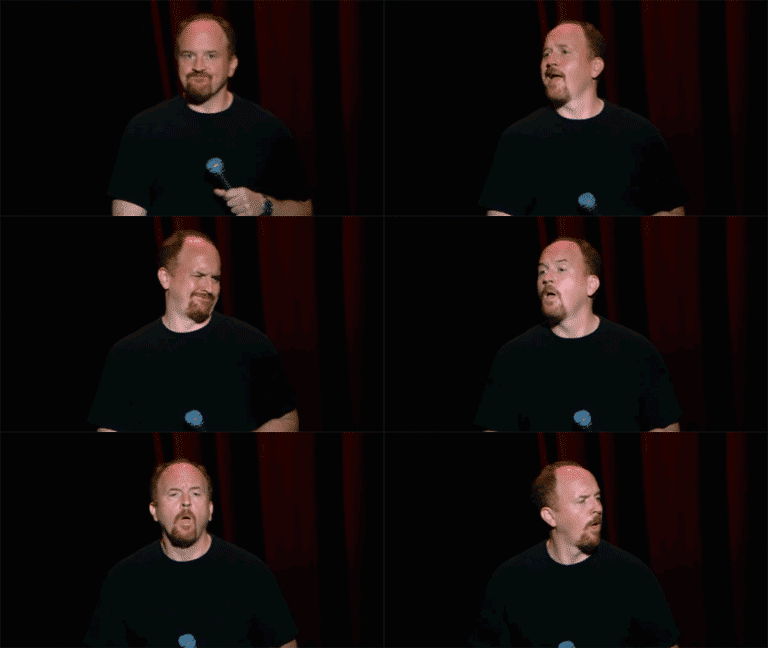
This week I made some major advances for my project. I finally started it. My main focuses this week has been analysis, writing, and a little bit of practicing/performing. As for analysis, I was mainly looking at Louis C.K. and his ability to put emphasis on certain words. Let's analyze together!

Image result for louis ck gifs


This statement serves as sort of the thesis statement for Lewis C.K.'s joke about monopoly. When he delivers these lines he puts special emphasis on the phrases "inevitable loss" and "every game". These two phrases are what make his thesis statement funny. They make the joke funny because of something called a comedic surprise in language. In your everyday life you are used to certain words falling into certain orders. You are probably used to hearing "losing in games", but when Louis C.K. adds in the words, "inevitable" and "every", he puts comedic emphasis on these words which throws off how you are normally used to hearing that line. Hence the joke is deemed funny. Another thing to key in on is how he pauses after he says those phrases (the quote is hyperlinked so that you can see how he says it). He pauses because he is placing the laughs of the audience between those phrases.

Image result for louis ck gifs

If you look at the end of the video, Louis C.K. does more laughter placing. This allows him to be in control of the stage and the audience which are both crucial parts of stand up. Watching Louis C.K. talk about his experiences with monopoly made me realize that I don't really have any normal board games at home. This encouraged me to write my very first routine. 


Looking back and assessing my comedy, I think that the first half was shaky and then it became much funnier towards the end of the bit. Something I feel like I could definitely work on is putting emphasis on specific words and telling jokes with more emotion. It seemed to me as if my language and my delivery were too monotone and didn't accurately convey the emotion that the joke should have delivered. While my jokes may not have been the funniest things in the world, they still showed some of the fundamentals to comedy that I need to improve on in the following weeks of this project.

p.s. interview with Joe Conklin has been completed and now I'm just waiting for the right blog to talk about it in. 

06 March 2017

Anticipation (3)

Over the past week I've undergone some intense comedic training. By intense comedic training I obviously mean, sitting on my couch and watching loads of comedians rant about babies. While this was partially for entertainment, not study, I did learn how to talk about something for long periods of time without exhausting your audience. This sort of information will help me once I begin to finally write some comedy next week. I know, everyone's been asking for some good jokes, but they're finally coming next week. I'm leaving this subject with a "to be continued" label. As for an expert, I have made some advances to try and get an interview with an undisclosed local comedian. Here's a hint: he does comedy based on Philadelphia sports and impressions. That's pretty much all I have. My project is nearing the tipping point where all of the good content comes out. As for now I'm going to have to leave everyone waiting on the edge of their seats until next post.

27 February 2017

Post Numero Dos (2)

Now that I'm a bit deeper into the project, I gotten a taste of stand-up comedy. I've learned a little bit about positioning on stage. Positioning is usually dependent on the joke that you're telling. I've also learned about rolling with jokes and reading the audience. I bet you're all saying to yourselves, "I can't wait for him to talk about all of his interesting findings in comedy." But the thing is, I'd rather not bore you. All of this comedy science may sound interesting but in reality, studying this material was not much more fun than swan-diving onto your child's Legos. What I am going to talk about though is the power of preparation. Comedy is all about preparation and so are many other things in life. Preparation is a key to any presentation. Preparing jokes before hand and knowing where you're walking into is crucial to being funny. This is interesting because it's not what you improvise on stage that necessarily makes you funny, it's the hard work that happens behind the scene that can make the difference between a great comedian and me. Jokes aren't the only things that need to be prepared, your positioning, and the joke you're going to use to cover up how bad your previous joke was. From now on whenever a class mate is worrying about what they are going to do the day of their presentation, tell them to worry about the days before the presentation.

15 February 2017

Pilot (1)

Here begins my six week journey of failing to learn how to be a stand up comedian. Every since I was a little kid I've always been inspired by the ability comedians have to make people happy. Now that a school project is forcing me into a new experience, I've decided to learn how to spread laughter and emotion. While it may get hard at times, the first steep is going to be to study and analyze popular comedians and see what makes them so funny. After that, I'm going to begin practicing positioning and speaking skills. This is all of course leading up to the last one or two weeks where I actually try to perform my own routines in front of a live audience. By the end of this process, I hope to transform myself into a full comedian. Right now, I think I could give 3 minutes of really cringy stand up after this project I want to be able to give an 8 to 10 minute stand up performance. This blog will track my progress and hopefully be a good place for me to post a funny joke every once in a while.